


Table of Contents
Transformation of Sentence English grammar-এর সবচেয়ে গুরুত্বপূর্ণ একটি টপিক। বিশেষ করে Affirmative to Negative এবং Negative to Affirmative পরিবর্তন SSC, HSC, Degree ও Honours পরীক্ষায় বারবার আসে।
এই পোস্টে আমরা Transformation of Sentence-এর সকল rules, shortcut techniques, structure, এবং 250+ examples (ব্যতিক্রমী নিয়ম ও ব্যাখ্যাসহ) একদম সহজ ভাষায় শিখবো। আপনি যদি এই একটি গাইড ভালো করে পড়েন, তবে গ্রামারের এই অংশে আপনার আর কোনো সমস্যা থাকবে না।
What is Transformation of Sentence?
Transformation of sentence is the process of changing the form of a sentence without changing its original meaning. (অর্থের কোনো পরিবর্তন না করে বাক্যের গঠন পরিবর্তন করাকেই Transformation of Sentence বলে।)
Sentence Transformation Shortcuts
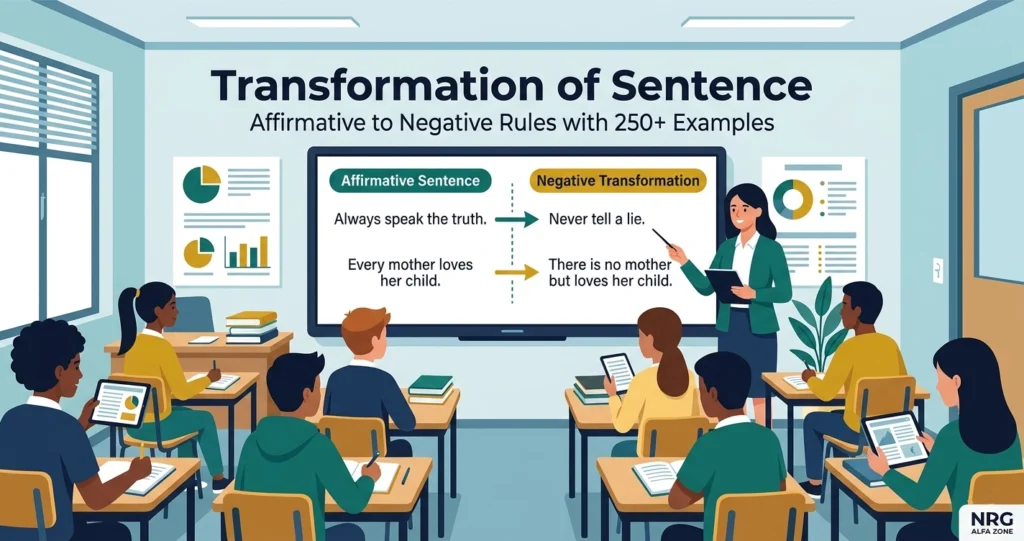
পুরো চ্যাপ্টারটি সহজে মনে রাখার জন্য নিচের শর্টকাট টেবিলটি মুখস্থ করে ফেলুন। এটি পরীক্ষার আগের রাতে রিভিশন দিতে দারুণ কাজ করবে।
| Affirmative Word | Negative Word (যা পরিবর্তন হয়ে বসবে) |
|---|---|
| Only / Alone (ব্যক্তি বুঝালে) | None but |
| Only (বস্তু বুঝালে) | Nothing but |
| Only (বয়স বা সংখ্যা বুঝালে) | Not more than / Not less than |
| Must / Have to / Has to | Cannot but + V1 বা Cannot help + V-ing |
| Had to (অতীত কাল) | Could not but + V1 বা Could not help + V-ing |
| Every + Noun | There is no + (Noun) + but |
| As soon as | No sooner had … than |
| Always | Never + (বিপরীত শব্দ) |
| Sometimes | Not always |
| Both … and / And | Not only … but also |
| Too … to | So … that + Sub + cannot/could not + V1 |
| As … as | Not less … than |
| Many | Not a few |
| A few | Not many |
| Much | Not a little |
| A little | Not much |
Rules of Affirmative to Negative
নিচে Affirmative to Negative Examples সহ বিস্তারিত নিয়ম দেওয়া হলো। বেসিক থেকে অ্যাডভান্স সব লেভেলের উদাহরণ (বিশেষ করে শেষের ১০টি কঠিন ও ব্যতিক্রমী উদাহরণের ব্যাখ্যাসহ) এখানে পাবেন।
Rule 1: Only / Alone
নিয়ম: Affirmative to Negative করার সময় “Only” বা “Alone” ব্যক্তি বুঝালে “None but” বসে। বস্তু বুঝালে “Nothing but” এবং বয়স/সংখ্যা বুঝালে “Not more than” বসে।
উদাহরণসমূহ (২৫টি):
Neg: None but Allah can help us.
Neg: He likes nothing but sweets.
Neg: She is not more than ten.
Neg: None but Raju was present.
Neg: I have not more than one pen.
Neg: None but a fool can do this.
Neg: The baby wants nothing but milk.
Neg: They need not more than 500 taka.
Neg: None but graduates can apply for this job.
Neg: Nothing but the moon was visible.
Neg: He solved not more than two problems.
Neg: I love none but you.
Neg: The man eats nothing but vegetables.
Neg: She bought nothing but a few books.
Neg: None but hard-working students succeed.
Neg: None but the brave deserve the fair.
(ব্যাখ্যা: Alone বাক্যের মাঝে থাকলেও None but বাক্যের শুরুতেই বসবে, কারণ এটি The brave বা ব্যক্তিকে মডিফাই করছে।)
Neg: Nothing but science can explain this.
(ব্যাখ্যা: Science বস্তুবাচক ধারণা, তাই Nothing but বসেছে।)
Neg: None but he is responsible for this.
(ব্যাখ্যা: alone এখানে he কে নির্দেশ করছে, তাই none but বাক্যের শুরুতে বসেছে।)
Neg: None but a scholar can solve this riddle.
Neg: I have to walk not more than two miles.
(ব্যাখ্যা: Two miles দূরত্ব বা সংখ্যা বুঝাচ্ছে, তাই not more than.)
Neg: Nothing but blood can wash away this stain.
(ব্যাখ্যা: Blood বস্তু/পদার্থ, তাই nothing but.)
Neg: Nothing but nature can heal him.
(ব্যাখ্যা: Nature বস্তুবাচক ধরা হয়।)
Neg: None but a mother knows the pain.
Neg: The ticket costs not more than a dollar.
(ব্যাখ্যা: A dollar মানে 1 dollar বা সংখ্যা।)
Neg: I met him no earlier than yesterday.
(ব্যতিক্রমী ব্যাখ্যা: এখানে Only দ্বারা সময় বোঝানো হয়েছে, তাই None but/Nothing but না বসে no earlier/other than বসেছে।)
Rule 2: Must / Have to / Has to / Had to
নিয়ম: বাক্যে Must, have to, বা has to থাকলে Negative করার সময় cannot but + V1 বসে। অতীতকাল (had to) থাকলে could not but + V1 বসবে। (চাইলে cannot help + V-ing ও ব্যবহার করা যায়)।
উদাহরণসমূহ (২৫টি):
Neg: We cannot but obey our parents.
Neg: You cannot but read the book.
Neg: I cannot but go there.
Neg: He cannot but do it.
Neg: We could not but leave the place.
Neg: Students cannot help wearing uniforms.
Neg: You cannot but complete the assignment.
Neg: She cannot but admit her fault.
Neg: They could not help surrendering.
Neg: Everyone cannot but die one day.
Neg: I cannot but support my family.
Neg: He could not but accept the proposal.
Neg: We cannot help respecting our teachers.
Neg: A mother cannot but love her child.
Neg: You cannot but attend the meeting.
Neg: Man cannot but submit to destiny.
Neg: I cannot but talk to him.
(ব্যাখ্যা: Need to থাকলেও বাধ্যবাধকতা বোঝায়, তাই cannot but বসে।)
Neg: She could not but leave.
(ব্যাখ্যা: forced to বা বাধ্য করা হলে অতীতকালের জন্য could not but বসে।)
Neg: We cannot but follow the rules.
(ব্যাখ্যা: bound to (বাধ্য) থাকলে must এর নিয়মেই negative হয়।)
Neg: They cannot but face challenges.
(ব্যতিক্রমী ব্যাখ্যা: inevitably (অনিবার্যভাবে) দ্বারা must এর অর্থ প্রকাশ পায়, তাই cannot but বসে।)
Neg: He cannot be anything but crazy to do this.
(ব্যতিক্রমী ব্যাখ্যা: Be verb এর পর Adjective থাকলে cannot be anything but বসানো শ্রুতিমধুর।)
Neg: You cannot help keeping your word.
Neg: I could not help crying to see his condition.
Neg: You cannot but go.
(ব্যাখ্যা: essential মানে বাধ্যতামূলক, তাই must এর নিয়ম।)
Neg: We cannot avoid facing the reality.
(ব্যতিক্রমী ব্যাখ্যা: cannot but এর বদলে cannot avoid + V-ing বসালেও অর্থ ঠিক থাকে।)
Rule 3: Every / All
নিয়ম: বাক্যের শুরুতে Every থাকলে There is no + (Noun) + but বসে।
উদাহরণসমূহ (২৫টি):
Neg: There is no mother but loves her child.
Neg: There is no man but wishes to be happy.
Neg: There is nobody but knows this.
Neg: There was no student but attended the class.
Neg: There is no man but is mortal.
Neg: There is no rose but has a thorn.
Neg: There is no cloud but has a silver lining.
Neg: There is no one who does not hate a liar.
Neg: There is no citizen but must obey the law.
Neg: There is no action but has an equal reaction.
Neg: There is none but must submit to death.
Neg: There is no patriot but loves his country.
Neg: There is no one but wants peace.
Neg: There was no building but was destroyed.
Neg: There is no mother who does not love her children.
Neg: No mother hates her child.
(ব্যতিক্রমী ব্যাখ্যা: বিপরীত শব্দ ব্যবহার করে Negative করা যায় যা বেশি স্ট্যান্ডার্ড এবং সুন্দর।)
Neg: No man can escape death.
(ব্যতিক্রমী ব্যাখ্যা: die এর বিপরীত escape death বা avoid death দিয়ে করা যায়।)
Neg: Nobody disbelieves an honest man.
(ব্যাখ্যা: Everybody -> Nobody এবং believes -> disbelieves).
Neg: None of them was absent.
(ব্যাখ্যা: বিপরীত শব্দ present -> absent).
Aff: Only some glittering things are gold.
Neg: There is no light without its shadow.
(ব্যতিক্রমী ব্যাখ্যা: ‘but has’ এর বদলে ‘without’ ব্যবহার করা যায়।)
Neg: There is no living thing that does not need water.
Neg: There is no problem without a solution.
Neg: There is no one but is liable to make mistakes.
Neg: Who does not fear death?
(ব্যতিক্রমী ব্যাখ্যা: Interrogative-Negative করেও অর্থ ঠিক রাখা যায়।)
Rule 4: As soon as
নিয়ম: As soon as যুক্ত sentence কে Negative করতে হলে No sooner had … than ব্যবহার করতে হয়।
উদাহরণসমূহ (২৫টি):
Neg: No sooner had he seen the tiger than he ran away.
Neg: No sooner had the teacher entered the class than the students stood up.
Neg: No sooner had I reached the station than the train left.
Neg: No sooner had it started raining than we went inside.
Neg: No sooner had the bell rung than the exam ended.
Neg: No sooner had he heard the news than he cried out.
Neg: No sooner had she finished her work than she went to bed.
Neg: No sooner had the sun risen than the fog dispersed.
Neg: No sooner had they seen the police than the thieves fled.
Neg: No sooner had the match started than the crowd cheered.
Neg: No sooner had I closed my eyes than I fell asleep.
Neg: No sooner had he got the message than he called me.
Neg: No sooner had the door opened than the dog ran out.
Neg: No sooner had she seen her mother than she smiled.
Neg: No sooner had the storm stopped than we went outside.
Neg: No sooner had the president arrived than the national anthem was played.
Neg: No sooner had the thief seen the police than he ran away.
(ব্যাখ্যা: as soon as বাক্যের মাঝে থাকলেও no sooner had বাক্যের শুরুতেই আসবে।)
Neg: No sooner had it stopped raining than he went out.
Neg: No sooner does he awaken than he checks his phone.
(ব্যতিক্রমী ব্যাখ্যা: বাক্যটি Present tense এ আছে, তাই had না বসে does বসেছে এবং V1 হয়েছে।)
Neg: No sooner do they arrive than the show will begin.
(ব্যাখ্যা: Present/Future tense এর জন্য do/does বসে।)
Neg: No sooner had I entered than he left.
(ব্যাখ্যা: ‘Just as’ থাকলেও ‘As soon as’ এর নিয়ম ফলো করে।)
Aff: As soon as he arrived, the bell rang.
Aff: As soon as the play started, the power went out.
Neg: No sooner had he seen me than he smiled.
(ব্যাখ্যা: The moment = As soon as).
Neg: No sooner had she spoken than everyone clapped.
Rule 5: Always / Sometimes
নিয়ম: Always থাকলে Never + (বিপরীত শব্দ) বসে। Sometimes থাকলে Not always বসে।
উদাহরণসমূহ (২৫টি):
Neg: He is never punctual.
Neg: I never forget you.
Neg: She is never sad.
Neg: They never tell a lie.
Neg: He never disagrees with me.
Neg: A patriot never hates his country.
Neg: We should never disrespect our elders.
Neg: The rich are not always happy.
Neg: He does not always visit us.
Neg: My friend is not always wise.
Neg: Never be dishonest.
Neg: I never rejected his offer.
Neg: He was never unmindful of his duties.
Neg: The weather is not always kind.
Neg: She never fails the exam.
Neg: Day laborers are not always happy.
(ব্যাখ্যা: Sometimes থাকায় Not always বসেছে, বিপরীত শব্দ লাগবে না)।
Neg: True love is never mortal.
Neg: I shall never forget your memory.
Neg: He is never absent from the meeting.
(ব্যাখ্যা: preposition ‘in’ পরিবর্তন হয়ে ‘from’ হয়েছে কারণ absent from হয়।)
Neg: A good boy is never disobedient.
Neg: He does not always make correct decisions.
(ব্যাখ্যা: অর্থের সৌন্দর্য রক্ষার্থে, direct word-to-word না করে sentence এর মিনিং ঠিক রাখা হয়েছে।)
Neg: Never speak ill of others.
(ব্যাখ্যা: well এর বিপরীত ill).
Neg: History never fails to repeat itself.
(ব্যতিক্রমী ব্যাখ্যা: repeats এর সরাসরি বিপরীত ক্রিয়া না থাকায় ‘fails to’ ব্যবহার করে negative করা হয়েছে।)
Neg: The sun never rises in the west.
Neg: I am never sure about his success.
(ব্যাখ্যা: doubtful এর বিপরীত sure).
Rule 6: Both…and / And
নিয়ম: দুটি Noun/Adjective যুক্ত থাকলে Not only … but also বসে।
উদাহরণসমূহ (২৫টি):
Neg: Not only Raju but also Saju are good boys.
Neg: He is not only honest but also kind.
Neg: I like not only tea but also coffee.
Neg: She took not only a pen but also a pencil.
Neg: Not only the teachers but also the students were present.
Neg: He ate not only apples but also oranges.
Neg: The man is not only poor but also helpless.
Neg: She bought not only a book but also a bag.
Neg: He was not only fined but also imprisoned.
Neg: They play not only football but also cricket.
Neg: Not only Rahim but also Karim will go there.
Neg: He is not only an actor but also a director.
Neg: We need not only time but also money.
Neg: The house is not only large but also beautiful.
Neg: He gave me not only food but also shelter.
Neg: He gave me not only books but also money.
(ব্যতিক্রমী ব্যাখ্যা: Besides … V+ing থাকলে Not only … but also দিয়ে Negative করতে হয়।)
Neg: He is not only clever but also hard-working.
(ব্যাখ্যা: as well as এর ক্ষেত্রেও একই নিয়ম।)
Neg: He is not only a writer but also a philosopher.
Neg: She knows not only English but also French.
Neg: He not only washed the car but also polished it.
(ব্যাখ্যা: দুটি Verb কে যুক্ত করেছে, তাই Not only verb এর আগে বসেছে।)
Neg: I saw not only a tiger but also a lion in the zoo.
Neg: They destroyed not only the village but also the forest.
Neg: Not only he but also his friends went there.
(ব্যাখ্যা: Along with থাকলেও subject দুটির সাথে not only…but also বসে।)
Neg: He is not only obedient but also gentle.
Neg: I need not only a phone but also a laptop immediately.
Rule 7: Too…to
নিয়ম: Too এর জায়গায় So বসে এবং to এর জায়গায় that + Subject + cannot/could not বসে।
উদাহরণসমূহ (২৫টি):
Neg: He is so weak that he cannot walk.
Neg: The man was so old that he could not work.
Neg: I am so tired that I cannot speak.
Neg: The boy is so small that he cannot touch the roof.
Neg: She is so lazy that she cannot shine in life.
Neg: He spoke so fast that he could not be understood.
Neg: The load is so heavy that I cannot carry it.
Neg: The water was so cold that we could not drink it.
Neg: The problem was so difficult that he could not solve it.
Neg: She was so shocked that she could not say a word.
Neg: He is so honest that he cannot take a bribe.
Neg: The box is so big that they cannot move it.
Neg: The soup is so hot that it cannot be eaten.
Neg: He is so proud that he cannot beg.
Neg: It is so good that it cannot be true.
Neg: The sum was so hard that the boy could not work it out.
(ব্যাখ্যা: for the boy থাকলে subject হিসেবে the boy বসে এবং শেষে it যুক্ত হয়)।
Neg: He is not so weak that he cannot carry the bag.
(ব্যতিক্রমী ব্যাখ্যা: enough to থাকলে বিপরীত শব্দ বসিয়ে not so…that দিয়ে করতে হয়।)
Neg: She is not so foolish that she cannot understand it.
Neg: He walked so slowly that he could not catch the train.
Neg: The night is so dark that we cannot go out.
Neg: He is so short that he cannot reach the shelf.
Neg: The tea is so hot that I cannot sip it.
Neg: He is so foolish that he cannot realize his mistake.
Neg: The news is so tragic that it cannot be told.
(ব্যাখ্যা: বস্তুবাচক Subject তাই cannot be told)।
Neg: I was so busy that I could not answer your call.
Rule 8: Degree Change
নিয়ম: As…as থাকলে Not less…than বসে। Comparative বা Superlative থেকে Positive Degree তে আনলে তা Negative হয়ে যায়।
(বিস্তারিত জানতে আমাদের Degree Change গাইডটি পড়ুন)
উদাহরণসমূহ (২৫টি):
Neg: Rahim is not less wise than Karim.
Neg: She is not less beautiful than her sister.
Neg: He is not less strong than a lion.
Neg: You are not less good than him.
Neg: The pen is not less fine than that.
Neg: Dhaka is not less busy than Mumbai.
Neg: He is not less tall than I.
Neg: Gold is not less valuable than diamond.
Neg: I am not as tall as he.
Neg: A bird does not fly as fast as a plane.
Neg: No other boy in the class is as good as he.
Neg: No other metal is as useful as iron.
Neg: No other peak is as high as Mount Everest.
Neg: Her brother is not as brilliant as she.
Neg: The deer is not as strong as the tiger.
Neg: Rahim is not as wise as Karim.
(ব্যাখ্যা: Less wise than নিজেই Affirmative অর্থ দেয়, তাই Negative করতে not as wise as বসে।)
Neg: Very few players are as good as he.
(ব্যাখ্যা: ‘Very few’ নিজেই একটি Negative/semi-negative শব্দ)।
Neg: I am not younger than you.
(ব্যতিক্রমী ব্যাখ্যা: not less old এর বদলে not younger বসানো আরও সুন্দর।)
Neg: A fox is not less cunning than a jackal.
Neg: I do not earn as much as he does.
Neg: That tree is not as old as this one.
Neg: No other playwright is as great as Shakespeare.
Neg: She typed not less fast than a professional.
Neg: Gold is not as precious as platinum.
Neg: No one else played as well as he.
Rule 9: Opposite Words
নিয়ম: Auxiliary Verb-এর পর Not বসে এবং মূল Adjective বা Verb-এর বিপরীত শব্দ বসে।
উদাহরণসমূহ (২৫টি):
Neg: He is not a bad man.
Neg: She is not ugly.
Neg: I am not sad.
Neg: The knife is not blunt.
Neg: The man is not dishonest.
Neg: He is not an inactive member.
Neg: I do not forget you.
Neg: This is not a difficult task.
Neg: We should not hate our country.
Neg: He did not disagree with me.
Neg: The water is not impure.
Neg: The glass is not empty.
Neg: He is not a poor man.
Neg: She was not absent from the meeting.
Neg: The decision was not wrong.
Neg: He is not without love for his parents.
(ব্যতিক্রমী ব্যাখ্যা: ‘loves’ এর বিপরীত ‘hates’ দিলে অর্থ খারাপ শোনায়, তাই ‘not without’ ব্যবহার করা হয়েছে।)
Neg: I am not sure if he will come.
(ব্যাখ্যা: doubt এর বিপরীত not sure).
Neg: He left no plan untried.
(ব্যাখ্যা: every -> no এবং tried -> untried).
Neg: It is not an easy nut to crack.
(ব্যাখ্যা: hard nut to crack একটি phrase যার অর্থ কঠিন কাজ।)
Neg: There is no way without a will.
Neg: He is not my enemy.
Neg: The weather is not cold today.
Neg: She is never unwilling to help.
Neg: The boy is not illiterate.
Neg: This is not impossible.
Rule 10: Many / Much
নিয়ম: Many থাকলে Not a few, Much থাকলে Not a little বসে। যেসব বাক্যের সরাসরি বিপরীত শব্দ নেই, সেগুলোকে Interrogative-Negative করতে হয়।
উদাহরণসমূহ (২৫টি):
Neg: I do not have a few friends.
Neg: He does not have many books.
Neg: There is not a little water in the pond.
Neg: I do not need much milk.
Neg: He did not buy a few apples.
Neg: She did not give me much hope.
Neg: They did not spend a little time there.
Neg: Not many students were present.
Neg: There are not a few stars in the sky.
Neg: He does not have a little money.
Neg: Isn’t he a doctor?
(ব্যাখ্যা: Doctor এর বিপরীত শব্দ নেই, তাই Interrogative-Negative করা হয়েছে।)
Neg: Don’t birds fly?
Neg: Isn’t the earth round?
(ব্যাখ্যা: চিরন্তন সত্য বাক্যকে Negative করতে হলে Interrogative-Negative করতে হয়)।
Neg: Doesn’t the sun rise in the east?
Neg: Isn’t honesty the best policy?
Neg: Isn’t milk white?
(ব্যাখ্যা: চিরন্তন সত্য এবং white এর সরাসরি বিপরীত রঙ নেই যা অর্থ ঠিক রাখবে। তাই প্রশ্নবোধক-নাবোধক ফরম্যাট।)
Neg: Man is not immortal.
(ব্যাখ্যা: এটি সাধারণ বিপরীত শব্দের নিয়মেই হয়, চিরন্তন সত্য হলেও এর বিপরীত শব্দ আছে।)
Neg: Doesn’t he know swimming?
(ব্যতিক্রম: know এর বিপরীত দিয়ে অর্থ ঠিক রাখা কঠিন)।
Neg: Don’t we read to learn?
Neg: Wasn’t Akbar a great king?
Neg: Doesn’t ice float on water?
Neg: Doesn’t he come here on Sundays?
Neg: I did not have a little trouble.
Neg: Not many men are truly happy.
Aff: Water is colorless.

Negative to Affirmative Rules
Negative to Affirmative করা খুবই সহজ! উপরে আমরা Affirmative থেকে Negative করার যে নিয়মগুলো শিখলাম, সেগুলোকে ঠিক উল্টোভাবে প্রয়োগ করলেই কাজ শেষ।
যেমন:
- বাক্যে None but থাকলে তা তুলে দিয়ে বাক্যের শুরুতে Only বসান।
- There is no…but থাকলে তা তুলে দিয়ে Every বসান।
- No sooner had…than থাকলে তা তুলে দিয়ে As soon as বসান।
Transformation of Sentence for SSC & HSC
SSC, HSC এবং Degree পরীক্ষার্থীদের জন্য নিচে কিছু গুরুত্বপূর্ণ Transformation of Sentence প্র্যাকটিস দেওয়া হলো:
Practice Yourself:
- Only Rahim was absent.
- He is too weak to run.
- Every student loves games.
- As soon as the bell rang, the teacher entered.
- Man is mortal.
Answers:
- None but Rahim was absent.
- He is so weak that he cannot run.
- There is no student but loves games.
- No sooner had the bell rung than the teacher entered.
- Man is not immortal.
Need more grammar? Check out our guides on: Voice Change, Narration, Right Forms of Verbs
Common Mistakes
Sentence Transformation-এর সময় শিক্ষার্থীরা সচরাচর যে ভুলগুলো করে:
- অর্থ পরিবর্তন করে ফেলা: Negative করার সময় অবশ্যই খেয়াল রাখতে হবে যেন মূল বাক্যের অর্থ ঠিক থাকে।
- Tense ভুল করা:
As soon asএর বাক্যে past tense থাকলেNo sooner hadএর পর অবশ্যই Verb এর 3rd form (V3) বসাতে হবে। - Question Mark (?) না দেওয়া: Interrogative-Negative (যেমন: Isn’t the earth round?) করার সময় বাক্যের শেষে প্রশ্নবোধক চিহ্ন না দিলে নম্বর কাটা যাবে।
Transformation of Sentence PDF
অনেকেই অফলাইনে পড়ার জন্য Transformation of Sentence PDF খুঁজে থাকেন। আমাদের এই সম্পূর্ণ গাইডটি আপনি চাইলে পিডিএফ আকারে সেভ করে রাখতে পারেন। আপনার ব্রাউজার থেকে Ctrl + P (বা মোবাইলে Print অপশন) চেপে খুব সহজেই এটি PDF হিসেবে Save করতে পারবেন।
❓ Important FAQs
What is transformation of sentence?
Transformation of sentence means changing the form of a sentence without changing its meaning. It is a key topic in English Grammar.
How to change affirmative into negative?
Affirmative sentences can be changed into negative using opposite words, structure changes like ‘no sooner’, ‘none but’, ‘cannot but’, etc.
What is the rule of only in transformation?
If “only” indicates a person, use “none but” at the beginning. If it indicates a thing, use “nothing but”. For age or numbers, use “not more than”.
What is the shortcut for affirmative to negative?
Using opposite words combined with auxiliary verbs and fixed structures (like Too…to = So…that) is the easiest shortcut technique.
Conclusion
এই Transformation of Sentence গাইডটি SSC, HSC, Degree এবং Honours শিক্ষার্থীদের জন্য অত্যন্ত গুরুত্বপূর্ণ। বিশেষ করে Affirmative to Negative rules ও Negative to Affirmative examples পরীক্ষার জন্য খুবই কমন। নিয়মগুলো নিয়মিত প্র্যাকটিস করলে ইংরেজিতে ভালো নম্বর নিশ্চিত!

